Generating Synthetic Data for Six Sigma and 5M Applications
In this section, we will explore the process of generating synthetic data using GPT-4 to fine-tune our LLMs (llama2, Zephyr, Falcon, Mistral) for industrial applications. particularly in the Six Sigma and 5M domain.
Synthetic Data Generation Process
Our decision to leverage synthetic data is driven by the need for a controlled and diverse dataset that encompasses a wide range of Six Sigma and 5M scenarios. Here is the syntax given to GPT-4 for generating the synthetic data:

Diversity Considerations
GPT-4 is employed to create synthetic scenarios that span different industrial settings, from manufacturing to service industries.
Emphasis is placed on simulating a variety of Six Sigma and 5M challenges, ensuring the models are exposed to a broad spectrum of scenarios.
Instruction Crafting
Instructions are carefully crafted to guide GPT-4 in generating responses aligned with Six Sigma and 5M principles.
Instructions cover scenarios related to DMAIC methodologies, 5S principles, Voice of the Customer analysis, and other Six Sigma, 5M concepts.
Quality Control
A rigorous quality control process is implemented to ensure the synthetic data’s relevance and coherence.
Validation against real-world scenarios is performed to guarantee that the synthetic data aligns with actual industrial challenges.
Data Integration with LLMs
Once synthetic data is generated, it undergoes integration with our LLMs for fine-tuning.
Data Input Format
Synthetic data is formatted to match the input requirements of llama2, Zephyr, Falcon, and Mistral or other large language model.
The format ensures that the synthetic data seamlessly integrates with each LLM’s unique architecture.
Fine-tuning Process
The synthetic data is utilized in the fine-tuning process, exposing the LLMs to a diverse set of scenarios.
Iterative fine-tuning sessions are conducted, allowing the models to adapt and learn from the synthetic data.
Validation
Models are rigorously validated against both real-world and synthetic scenarios to assess their performance.
The validation process ensures that the LLMs effectively generalize their knowledge from synthetic data to real-world industrial challenges.
Six Sigma Domain Integration
Understanding the Six Sigma domain is crucial for ensuring the LLMs produce meaningful and relevant outputs aligned with industry best practices.
Understanding Six Sigma
Six Sigma is a data-driven methodology for process improvement, emphasizing defect reduction and efficiency enhancement.
Key principles include DMAIC (Define, Measure, Analyze, Improve, Control), 5S methodology, and continuous improvement.
Customization for Six Sigma
LLMs are tailored to understand and respond to Six Sigma-related prompts, ensuring alignment with industry standards.
Fine-tuning involves exposure to diverse Six Sigma scenarios, allowing models to adapt their responses accordingly.
Quality Metrics
Six Sigma metrics, including defect rates, process efficiency, and customer satisfaction, play a crucial role in evaluating LLM performance.
The integration ensures that LLM-generated solutions are measurable and aligned with Six Sigma quality standards.
Examples
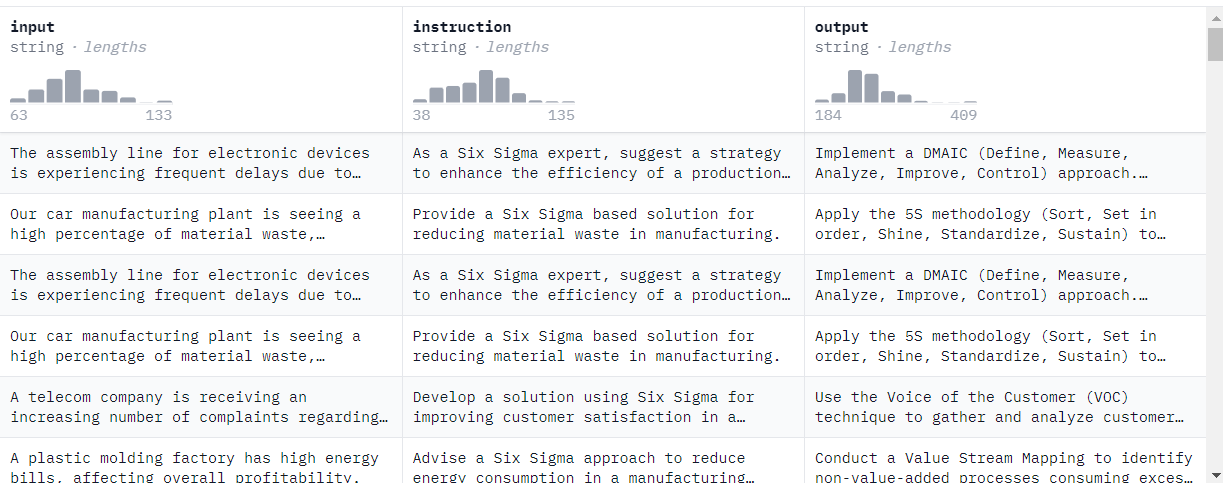
Explore examples of synthetic data generation and the subsequent integration with LLMs for Six Sigma scenarios. Here is a glimpse to six sigma and 5M dataset:

Generating Sample Data
Synthetic data showcases diverse scenarios, covering industries such as manufacturing, healthcare, and logistics.
Examples include challenges in supply chain optimization, defect reduction in manufacturing, and service quality improvement.
Integrating with Six Sigma Use Cases
LLM-generated solutions are seamlessly integrated into Six Sigma use cases, demonstrating adaptability and effectiveness.
Use cases cover scenarios from different industries, emphasizing the applicability of fine-tuned models.
Quality Assurance
Rigorous quality assurance processes ensure the accuracy and relevance of LLM-generated solutions.
Validation against real-world scenarios and Six Sigma principles validates the effectiveness of the fine-tuned models.
Quality Metrics and Evaluation
To gauge the effectiveness of the fine-tuned models, we employ a set of quality metrics and evaluation techniques.
Metric Selection
Metrics such as accuracy, precision, recall, and F1 score quantify LLM performance.
Six Sigma-specific metrics, including defect rates and process efficiency, provide a comprehensive evaluation.
Validation against Real-world Data
Fine-tuned models are validated against real-world Six Sigma scenarios, ensuring practical applicability and effectiveness.
Next Steps and Recommendations
With the LLMs fine-tuned using synthetic data, the next steps involve deploying them in industrial environments.
Deployment
Deploy fine-tuned LLMs in real-world industrial settings, including manufacturing plants, supply chain management, and service industries.
Ongoing Monitoring
Continuously monitor models to identify drift or degradation in performance over time.
Regular updates and re-training based on ongoing monitoring results to maintain adaptability.
Areas for Improvement
Periodically revisit the synthetic data generation process to incorporate new challenges.
Ensure models remain adaptable to evolving industrial scenarios through continuous improvement.